

― Dave Eggers, The Circle
Big Read Lakeshore 2026 Book
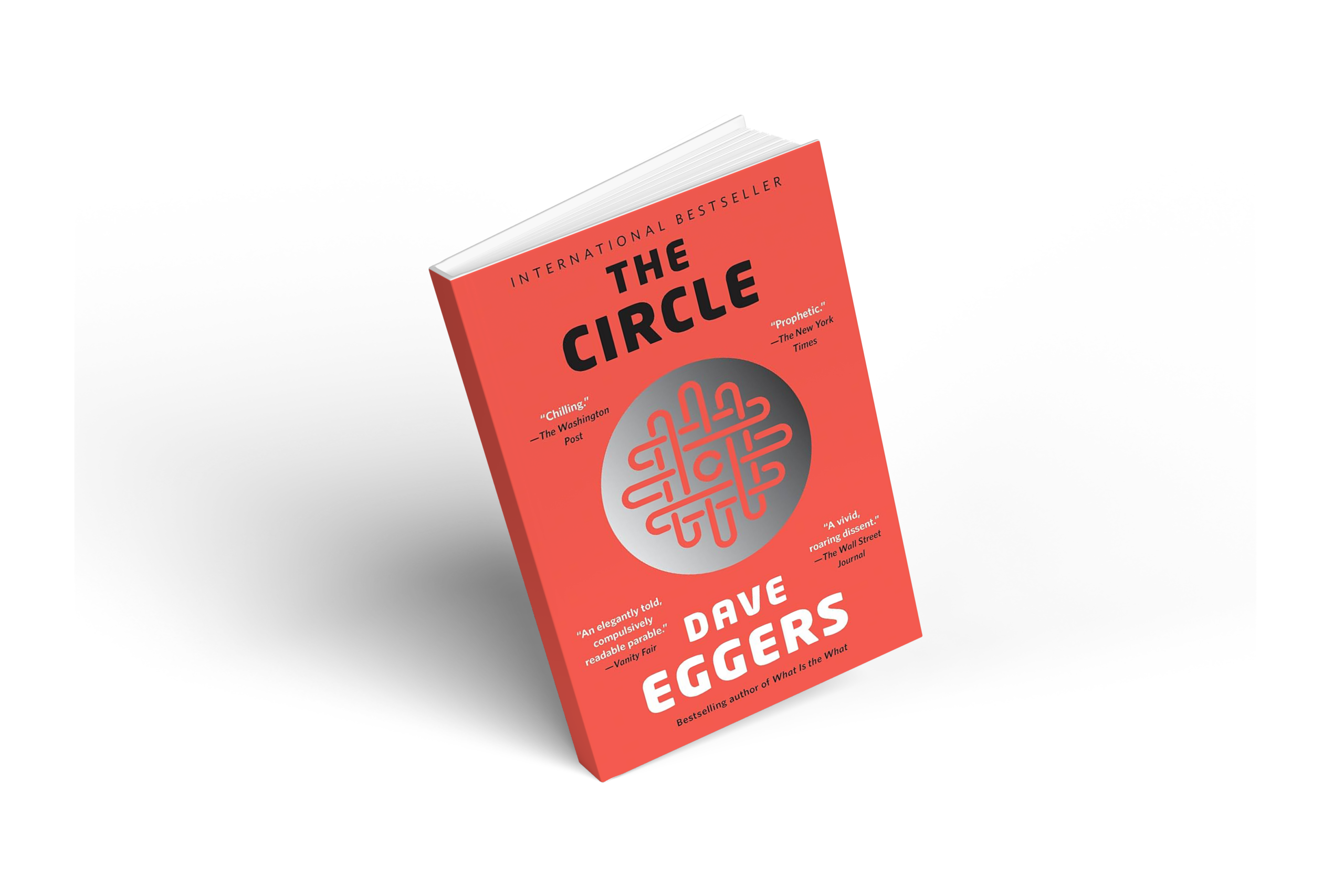
The Circle
Dave Eggers
“Better to be at the bottom of a ladder you want to climb than in the middle of some ladder you don’t, right?”
Book Summary
When Mae Holland is hired to work for the Circle, the world’s most powerful internet company, she feels she’s been given the opportunity of a lifetime. The Circle, run out of a sprawling California campus, links users’ personal emails, social media, banking, and purchasing with their universal operating system, resulting in one online identity and a new age of civility and transparency.
As Mae tours the open-plan office spaces, the towering glass dining facilities, the cozy dorms for those who spend nights at work, she is thrilled with the company’s modernity and activity. There are parties that last through the night, there are famous musicians playing on the lawn, there are athletic activities and clubs and brunches, and even an aquarium of rare fish retrieved from the Marianas Trench by the CEO.
Mae can’t believe her luck, her great fortune to work for the most influential company in the world—even as life beyond the campus grows distant, even as a strange encounter with a colleague leaves her shaken, even as her role at the Circle becomes increasingly public.
What begins as the captivating story of one woman’s ambition and idealism soon becomes a heart-racing novel of suspense, raising questions about memory, history, privacy, democracy, and the limits of human knowledge.
About The Author
Dave Eggers

Dave Eggers is the author of many books, among them Contrapposto, The Eyes and the Impossible, The Circle, The Monk of Mokha, Heroes of the Frontier, A Hologram for the King, and What Is the What. He is the founder of McSweeney’s, an independent publishing company, and co-founder of 826 Valencia, a youth writing center that has inspired over 70 similar organizations worldwide. Eggers is winner of the American Book Award, the Muhammad Ali Humanitarian Award for Education, the Dayton Literary Peace Prize, the TED Prize, and has been a finalist for the National Book Award, the Pulitzer Prize, and the National Book Critics Circle Award. He is the 2024 John Newbery Medalist, for the most distinguished contribution to children’s literature for The Eyes and the Impossible. Eggers is a member of the American Academy of Arts and Letters.
Reviews
“Fascinating . . . Eggers appears to run on pure adrenaline, and has as many ideas pouring out of him as the entrepreneurs pitching their inventions in The Circle . . . [A] novel of ideas . . . about the social construction and deconstruction of privacy, and about the increasing corporate ownership of privacy, and about the effects such ownership may have on the nature of Western democracy . . . Like Melville’s Pequod and Stephen King’s Overlook Hotel, the Circle is a combination of physical container, financial system, spiritual state, and dramatis personae, intended to represent America, or at least a powerful segment of it . . . The Circlers’ social etiquette is as finely calibrated as anything in Jane Austen . . . Eggers treats his material with admirable inventiveness and gusto . . . the language ripples and morphs . . . It’s an entertainment, but a challenging one.”
—Margaret Atwood, The New York Review of Books
“Eggers is a literary polymath . . . The Circle is funny in its skewering of Internet culture. Holland obsessively tallies the reach of her Twitter-like Zings and enthuses about a benefit for needy children that raises not money but 2.3 million ‘smiles’ (think Facebook ‘likes’). The Circle’s buildings are named for epochs, so at her first party Holland gets her wine from the Industrial Revolution . . . The ideas behind “The Circle” are compelling and deeply contemporary. Holland is an everywoman, a twentysomething believer in Internet culture untroubled by the massive centralization and monetization of information, ubiquitous video surveillance and corporate invasions of privacy. Compare that to A Hologram for the King, in which a middle-aged man thoughtfully but powerlessly observes America’s economic decline, realizing that his efforts to participate in globalization led to his own obsolescence. The two books together are saying something foreboding about America’s place in the world: We have traded making physical things for a glossy, meaningless online culture that leaves us vulnerable to those who see that information — in the form of data, video feeds, or our own consumer desires — is power.”
—Los Angeles Times
Photo by Israel Andrade on Unsplash